

The appendicular skeleton of Neuquensaurus, a Late Cretaceous saltasaurine sauropod from Patagonia, Argentina

Neuquensaurus, from the Late Cretaceous of Argentina and one of the first dinosaurs described from Patagonia, is one of the most derived sauropod dinosaurs, and its proportions and size place it among the smallest sauropods ever known. In this context, Neuquensaurus is central to understanding late stages of sauropod evolution. This contribution offers a full description of the appendicular skeleton of Neuquensaurus. The anatomical analysis reveals that the appendicular skeleton of Neuquensaurus exhibits unique characteristics only shared with closely related saltasaurine titanosaurs; for example, the laterally directed preacetabular lobe of the ilium, the prominent fibular lateral tuberosity, and the presence of an intermuscular line on the femoral shaft, which is proposed here as a synapomorphy of Saltasaurinae. Neuquensaurus also displays many reversals to primitive character states, such as the presence of a prominent olecranon process of the ulna, a trochanteric shelf, a lesser trochanter and an ischial tuberosity. Additional characters that allow its evaluation in a phylogenetic context are here provided. Among them are the extremely deflected femoral shaft, the elliptical femoral cross−section, and the anterolaterally oriented cnemial crest.
Otero, A. 2010. The appendicular skeleton of Neuquensaurus, a Late Cretaceous saltasaurine sauropod from Patagonia, Argentina. Acta Palaeontologica Polonica 55 (3): 399–426.
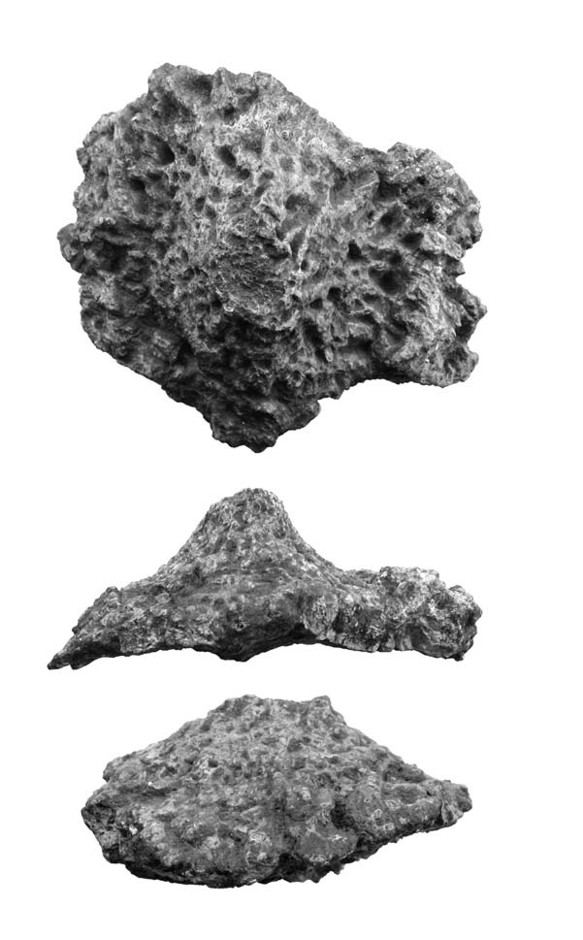
Dermal armor histology of Saltasaurus loricatus, an Upper Cretaceous sauropod dinosaur from Northwest Argentina
Ignacio Cerda and Jaime Powell
The first unambiguous evidence of the presence of osteoderms in sauropod dinosaurs came from the discovery of Saltasaurus loricatus, a titanosaur from the Upper Cretaceous of Argentina. The dermal armor of Saltasaurus is composed of bony plates and small dermal ossicles. Here, we analyze the bone microstructure of these elements and provide information regarding its origin and development. The bony plates are composed almost entirely of reconstructed cancellous bone. Remains of primary bone consist of coarse bundles of mineralized collagenous fibers towards the external surface. Also, woven fibered bone tissue appears in the basal and lateral regions. Dermal ossicles lack secondary remodeling, and their matrix is formed by three orthogonal systems of collagenous fiber bundles. Growth lines are present in both bony plates and ossicles. Bone histology reveals that osteoderms mainly originated through direct mineralization (metaplasia) of the dermis, although other mechanisms are also involved (at least in the origin of dermal plates). The common features of development and integumental location of the osteoderms of Saltasaurus and other non−related vertebrates (e.g., lepidosaurs, crocodylomorphs) are linked to the intrinsic skeletogenic properties of the dermis.
Cerda, I.A. and Powell, J.E. 2010. Dermal armor histology of Saltasaurus loricatus, an Upper Cretaceous sauropod dinosaur from Northwest Argentina. Acta Palaeontologica Polonica 55 (3): 389–398.
A medium-sized ornithopod, Bajo Barreal formation, Chubut, Argentina
0 comentarios Publicado por Leonardo Filippi en 7:22
A medium-sized ornithopod (Dinosauria: Ornithischia) from the Upper Cretaceous Bajo Barreal Formation of Lago Colhué Huapi, Southern Chubut Province, Argentina.
Lucio M. Ibiricu, Rubén D. Martínez, Matthew C. Lamanna, Gabriel A. Casal, Marcelo Luna, Jerald D. Harris and Kenneth J. Lacovara
An associated partial postcranial skeleton is described as the third definitive ornithopod dinosaur record from the Upper Cretaceous Bajo Barreal Formation of central Patagonia, Argentina. Specifically, the specimen was recovered from the uppermost Cretaceous (Campanian–?Maastrichtian) Upper Member of the Bajo Barreal exposed on an ephemeral island in the southeastern portion of Lago Colhué Huapi in southern Chubut Province. Identifiable elements of the skeleton include four incomplete dorsal vertebrae, three partial anterior caudal vertebrae, a middle caudal neural arch, an incomplete posterior caudal vertebra, a dorsal rib fragment, the right calcaneum, and portions of the left metatarsal III and right metatarsal IV. Comparisons with corresponding elements in other ornithischians indicate that the material pertains to a medium-sized, non-hadrosaurid ornithopod. In particular, the morphology of the calcaneum is characteristic of ornithopods of this “grade”. The new discovery augments our understanding of the latest Cretaceous terrestrial vertebrate assemblage of central Patagonia and adds to the generally meager record of ornithischians in the Late Cretaceous of the Southern Hemisphere.
Ibiricu, L. M., Martínez, R. D., Lamanna, M. C., Casal, G. A., Luna, M., Harris, J. D., and Lacovara, K. J., 2010. A medium-sized ornithopod (Dinosauria: Ornithischia) from the Upper Cretaceous Bajo Barreal formation of Lago Colhué Huapi, southern Chubut province, Argentina. Annals of CarnegieMuseum 79 (1):39–50.
A basal Archosauriform from the Lower Triassic of Argentina
0 comentarios Publicado por Leonardo Filippi en 6:24
A New basal Archosauriform Diapsid from the Lower Triassic of Argentina.
Martín D. Ezcurra, Agustina Leucona and Agustín Martinelli
The best-known South American Early Triassic archosauriform belongs to a putative proterosuchid briefly reported by José Bonaparte in 1981, collected from the Quebrada de los Fósiles Formation (Puesto Viejo Group, Argentina). This specimen consists of well-preserved natural external molds of a partial postcranium that preserve dorsal vertebrae, osteoderms, a dorsal rib, a possible gastralium, a chevron, a humerus, an ilium, two metapodials, ungual. Were-describe this specimen and identify autapomorphies that allow us to recognize Koilamasuchus gonzalezdiazi, gen. et sp. nov. The presence of an iliac blade with a slightly convex dorsal margin and with a maximum length more than 3 times its maximum height places Koilamasuchus within Archosauriformes. A cladistic analysis of basal Archosauriformes positions Koilamasuchus more crownwards than Proterosuchus, Sarmatosuchus, Fugusuchus, and Osmolskina, as the sister taxon of the clade that includes Erythrosuchidae and Archosauria. Proterosuchidae is found to be paraphyletic. The presence of an iliac preacetabular process, a pubic peduncle that forms an angle lower than 45◦ to the longitudinal axis of the ilium, and dorsal body osteoderms positions Koilamasuchus in Archosauriformes more crownwards than proterosuchids. Koilamasuchus is more basal than erythrosuchids within Archosauriformes because of the presence of dorsal ribs with a poorly developed proximal end. Koilamasuchus importantly increases the diversity of Archosauriformes during the biotic recovery following the Permo-Triassic mass extinction.
Ezcurra, M.D., Leucona, A. and Martinelli, A., 2010. A New Basal Achosauriform Diapsid from the Lower Triassic of Argentina. Journal of Vertebrate Paleontology 30(5):1433–1450.
New information on the cranial and vertebral anatomy of Buitreraptor gonzalezorum
0 comentarios Publicado por Leonardo Filippi en 6:20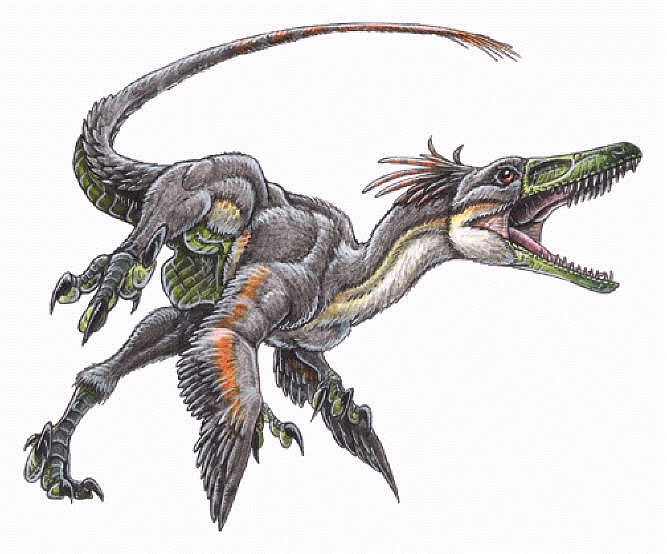
New information on the cranial and vertebral anatomy of Buitreraptor gonzalezorum (Theropoda, Unenlagiinae) and preliminary comparisons with other South American unenlagiines
F.A. GIanechini, S. Apesteguía and P.J. Makovicky
Within the framework of a doctoral thesis about the small theropods coming from the Cerro Policía area (Candeleros Formation, Río Negro Province), novel information of Buitreraptor gonzalezorum Makovicky, Apesteguía and Agnolín 2005 is presented here, including partial comparisons with other unenlagiines. Shared cranial characters between Buitreraptor and Austroraptor cabazai Novas, Pol, Canale, Porfiri and Calvo 2009 include: skull exceeding femoral length by 25%; low anterior process of maxilla; large maxillary fenestra not dorsally displaced; more than twenty maxillary and dentary teeth; fluted teeth without serrations and without basal constriction; groove on the dentary containing a row of nutrient foramina. Otherwise, Buitreraptor differs from Austroraptor in having a larger maxillary fenestra; elongated frontals with dorsal depressions; triangular postorbital; compressed teeth, with an 8-shaped basal section. Concerning vertebral features, Buitreraptor has a ventral faint keel on the axis (not comparable with other unenlagiines); elongated medial cervicals; epipophyses on all cervicals; carotid process on the latest cervicals; ventrolateral ridges on the last cervical culminating posteriorly as small tubers; neural spines of the dorsals without distal spine tables (this latter feature invalidates a proposed synapomorphy for Unenlagiinae). Additionally, whereas pleurocoels are restricted to anterior dorsals in Buitreraptor (and probably in Austroraptor), in Unenlagia comahuensis Novas and Puerta 1997 they are in anterior and posterior dorsals; and the foramina that pierces the base of the neural spines in the latter are absent in the two former. This analysis increases the knowledge of the anatomy of Buitreraptor and shows a high internal variability among unenlagiines
Fuente: XXV Jornadas Argentinas de Paleontología de Vertebrados, San Luis, 2010.

Primitive broad-crowned titanosaurs in the Uppermost Cretaceous?
P.A. Gallina, S. Apesteguía and F.A. Gianechini
Despite several tooth morphologies were recognized in sauropods, it is widely accepted that macronarians exhibit two main morphotypes: broad-crowned teeth and narrow-crowned teeth. The former, spoon-shaped and provided of a main axis and two lateral flanges, is present in basal forms like Camarasaurus Cope. Conversely, the latter, with reduced flanges, is considered as characteristical for derived titanosaurs, notwithstanding this ―narrow tooth concept actually masks a hidden diversity of morphologies (i.e., cylindrical, hexagonal prisms, and double-ridged). Otherwise, the diversity of Upper Cretaceous dental morphotypes includes also two broader forms. One is represented by broad, distally acuminated, labiolingually compressed, and spatulated crowns, similar but much lesser than that of Camarasaurus Cope, and present in undoubted titanosaurs like Ampelosaurus Le Loeuff from France. The other is represented by labiolingually compressed and distally acuminated teeth with a D-shaped crown slightly broader than the root, and both lingual and lateral high-angled wear facets that resembles those of basal titanosauriforms (e.g., Brachiosaurus Riggs). This type is well represented in Argentina, as show the teeth from the Arroyo Morterito (Salta, PVL 3670-12), some smaller teeth from Los Alamitos Formation (MACN 1133RN), isolated tooth from the Allen Formation (MMRM-PV 53). The presence of this kind of teeth in Campanian-Maastrichtian strata can be attributed both to the presence of surviving basal titanosaurian lineages and/or, the preservation of plesiomorphical traits in the dental morphology of late lineages like the Saltasaurinae.
Fuente: XXV Jornadas Argentinas de Paleontología de Vertebrados, San Luis, 2010.
Foto: solo a modo ilustrativo.
Foto: solo a modo ilustrativo.

A new early dinosaur (Saurischia: Sauropodomorpha) from the Late Triassic of Argentina: a reassessment of dinosaur origin and phylogeny
Martin D. Ezcurra
It was traditionally thought that the oldest known dinosaur assemblages were not diverse, and that their early diversificationband numerical dominance over other tetrapods occurred during the latest Triassic. However, new evidence gathered from the lower levels of the Ischigualasto Fm. of Argentina challenges this view. New dinosaur remains are described from this stratigraphical unit, including the new species Chromogisaurus novasi. This taxon is distinguished from other basal dinosauriforms by the presence of proximal caudals without median notch separating the postzygapophyses, femoral lateral surface with deep and large fossa immediately below the trochanteric shelf, and metatarsal II with strongly dorsoventrally asymmetric distal condyles. A phylogenetic analysis found Chromogisaurus to lie at the base of Sauropodomorpha, as a member of Guaibasauridae, an early branch of basal sauropodomorphs composed of Guaibasaurus, Agnosphitys, Panphagia, Saturnalia and Chromogisaurus. Such an affinity is for the first time suggested for Guaibasaurus, whereas Panphagia is not recovered as the most basal sauropodomorph. Furthermore, Chromogisaurus is consistently located as more closely related to Saturnalia than to any other dinosaur. Thus, the Saturnalia + Chromogisaurus clade is named here as the new subfamily Saturnaliinae. In addition, Eoraptor is found to be the sister-taxon of Neotheropoda, and herrerasaurids to be non-eusaurischian saurischians. The new evidence presented here demonstrates that dinosaurs first appeared in the fossil record as a diverse group, although they were a numerically minor component of faunas in which they occur. Accordingly, the early increase of dinosaur diversity and their numerical dominance over other terrestrial tetrapods were diachronous processes, with the latter preceded by a period of low abundance but high diversity.
Ezcurra, M.D. 2010. A new early dinosaur (Saurischia: Sauropodomorpha) from the Late Triassic of Argentina: a reassessment of dinosaur origin and phylogeny. Palaeontology, 8: 3, 371-425
;;
Subscribe to:
Entradas (Atom)


