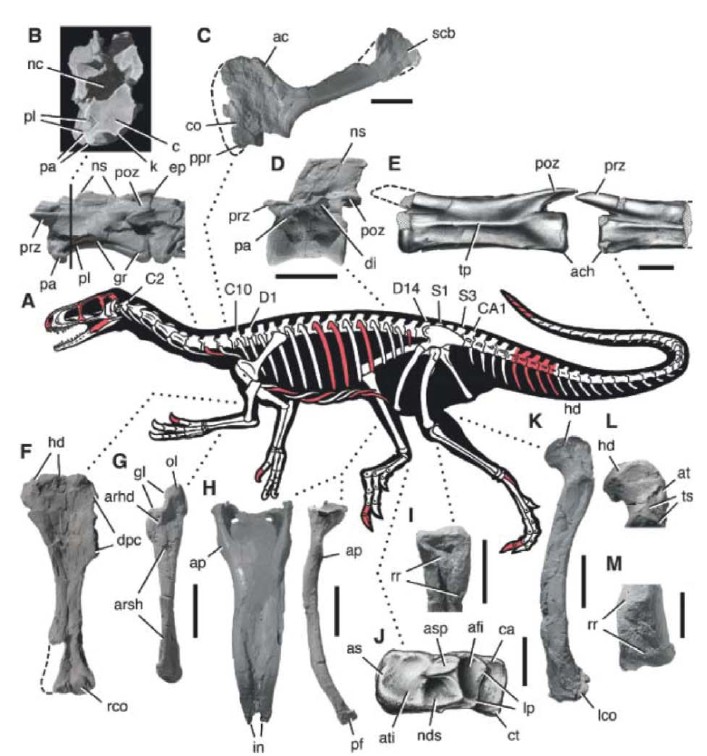
A Basal Dinosaur from the Dawn of the Dinosaur Era in Southwestern Pangaea
Ricardo N. Martinez, Paul C. Sereno, Oscar A. Alcober, Carina E. Colombi, Paul R. Renne, Isabel P. Montañez, Brian S. Currie
Upper Triassic rocks in northwestern Argentina preserve the most complete record of dinosaurs before their rise to dominance in the Early Jurassic. Here, we describe a previously unidentified basal theropod, reassess its contemporary Eoraptor as a basal sauropodomorph, divide the faunal record of the Ischigualasto Formation with biozones, and bracket the formation with 40Ar/39Ar ages. Some 230 million years ago in the Late Triassic (mid Carnian), the earliest dinosaurs were the dominant terrestrial carnivores and small herbivores in southwestern Pangaea. The extinction of nondinosaurian herbivores is sequential and is not linked to an increase in dinosaurian diversity, which weakens the predominant scenario for dinosaurian ascendancy as opportunistic replacement.
Martinez, R. N., Sereno, P. C., Alcober, O. A., Colombi, C. E., Renne, P. R., Montañez, I. P., Currie, B. C., 2011. A Basal Dinosaur from the Dawn of the Dinosaur Era in Southwestern Pangaea. Science. 331: 206-210.

New remains of Astraponotus (Mammalia, Astrapotheria) and considerations on Astrapothere cranial evolution

Alejandro G. Kramarz, Mariano Bond and Analia M. Forasiepi
Astraponotus Ameghino, 1901, the only valid Mustersan (late Eocene) astrapothere, typifies the Ameghino’s ‘‘Capas Astraponotenses’’. This taxon is traditionally interpreted as structurally ancestral to all the Oligocene– Miocene astrapotheriids. However, it was imperfectly known: only isolated teeth and very partial mandibles have hitherto been described. In this contribution we provide the first description of the skull, mandible, and complete dentition of Astraponotus based on new materials from the Gran Hondonada and other Mustersan localities in central Patagonia, Argentina. The features observed in the dentition of Astraponotus are intermediate between the Casamayoran (middle Eocene) and the Oligocene–Miocene astrapotheres in the degree of hypsodonty, reduction of the dental formula, and development of accessory occlusal elements. Concordantly, the skull retains some plesiomorphies, also observed in Trigonostylops, whereas the auditory region and the basicranium are much closer to those of Parastrapotherium, Astrapotherium, and Granastrapotherium. On the other hand, the skull of Astraponotus differs from all known astrapotheres by the disproportioned height and narrowness of the braincase, the extreme reduction of the nasals and the premaxillaries, the absence of anteorbital rim, and the reduction of the frontal region. Some of these features represent cranial specializations exactly opposite to that of Astrapotherium. These characters look astonishingly derived for an Eocene astrapothere, suggesting that extreme cranial specializations occurred independently during the evolution of the order, and that Astraponotus represents a distinctive lineage from that of Astrapotherium and other Miocene forms.
Kramarz, A. G., Bond M. and Forasiepi, A. M., 2010. New remains of Astraponotus (Mammalia, Astrapotheria) and considerations on Astrapothere cranial evolution. Paläontol Z. DOI 10.1007/s12542-010-0087-4.
A glimpse at the ontogeny of the Calyptocephalella canqueli
0 comentarios Publicado por Leonardo Filippi en 6:25
A glimpse at the ontogeny of the fossil neobatrachian frog Calyptocephalella canqueli from the Deseadan (Oligocene) of Patagonia, Argentina

Paula Muzzopappa and Laura Nicoli
Two fossil tadpoles collected in the Deseadan levels (Oligocene) at the Scarritt Pocket locality of central Patagonia are studied herein. These specimens, which show different degrees of skeletal development, have been assigned to the neobatrachian Calyptocephalella canqueli based on the morphology of the frontoparietals and the presence of adult spec− imens of this fossil species at the same locality. The concurrent analysis of three developmental stages (Gosner Stages 35/36 and 38/39, and adult) has provided significant data about the ontogeny of this species, including the change of the pattern of exostosis of the frontoparietals, from a pitted to a tuberculated pattern, and the corroboration of the inclusion of two neural arches in the formation of the urostyle. This evidence will shed light on developmental mechanisms that might be involved in the evolution of the genus Callyptocephalella.
Muzzopappa, P. and Nicoli, L. 2010. A glimpse at the ontogeny of the fossil neobatrachian frog Calyptocephalella canqueli from the Deseadan (Oligocene) of Patagonia, Argentina. Acta Palaeontologica Polonica 55 (4): 645–654.
Predation bite-marks on a peirosaurid crocodyliform
0 comentarios Publicado por Leonardo Filippi en 15:09
Predation bite-marks on a peirosaurid crocodyliform from the Upper Cretaceous of Neuquén Province, Argentina

Lucas Ernesto Fiorelli
Abstract. Bite marks and injuries caused by intraspecific predation or aggressive social behavior are uncommon in fossil vertebrates, and in the fossil record of suchian archosaurs they are extremely unusual. A peirosaurid crocodyliform collected from the Upper Cretaceous beds of the Neuquén Group (northern Patagonia, Argentina) shows abundant bite marks and injuries. These injuries are spread across all the preserved parts of the specimen, with the highest concentration of bite marks, perforations and breakage in the caudal region. Characteristics of these injuries are analyzed, and their possible origin and related taphonomic aspects are assessed. Results indicate that the injuries were not produced by intraspecific fighting, but probably by the predating action of a theropod dinosaur.
Resumen. El hallazgo de marcas de mordeduras y lesiones por predación o comportamiento social agresivo intraespecífico en vertebrados fósiles es poco frecuente. En el registro fósil de arcosaurios suquianos tales evidencias son extraordinarias. Aquí se reporta un crocodiliforme peirosáurido del Cretácico Superior del Grupo Neuquén (norte de Patagonia, Argentina) con abundantes marcas de mordeduras y lesiones. Estas heridas están localizadas en todas las partes preservadas del espécimen, con una alta concentración de mordeduras, perforaciones y roturas en la región caudal. En el presente trabajo, se analizan las características de las lesiones, y también sus posibles causas y los aspectos tafonómicos relacionados. Los resultados muestran que las mordeduras fueron hechas por la acción de un predador y no por peleas intraespecíficas.
Fiorelli, L. E., 2010. Predation bite-marks on a peirosaurid crocodyliform from the Upper Cretaceous of Neuquén Province, Argentina. Ameghiniana 47 (3): 387-400.
Cranial endocast of the Giganotosaurus carolinii
3 comentarios Publicado por Leonardo Filippi en 13:53Cranial endocast of the carcharodontosaurid theropod Giganotosaurus carolinii Coria & Salgado, 1995
Ariana Paulina Carabajal and Juan Ignacio Canale
A complete endocast of Giganotosaurus carolinii Coria & Ssalgado, 1995 was made in latex after removing mechanically the sediment filling of the cerebral cavity of the braincase, thereby allowing the description of the endocranial anatomy of the specimen. The endocast was compared with the other few known natural or artificial theropod endocasts, including the two species of the African allosauroid species Carcharodontosaurus saharicus and C. idiguensis. As in Carcharodontosaurus, the olfactory bulbs in Giganotosaurus are aligned with the forebrain, the midbrain is posteroventrally inclined and the hindbrain is parallel but ventral to the forebrain, showing similarly angled cephalic and pontine flexures. The cranial nerves and blood vessels have a similar disposition as in Carcharodontosaurus saharicus. However, in Giganotosaurus there is only one branch for cranial nerve XII, and cranial nerve XI has a separate internal opening from the vagus foramen (metotic foramen). In C. saharicus, there is a separate opening as well, but it is anterior in position and was probably utilized by cranial nerve IX. The length of the endocast of Giganotosaurus, including the olfactory bulbs, is approximately 19 % longer than the endocast in Carcharodontosaurus saharicus.
Paulina Carabajal, A. & Canale, J. I. ,2010: Cranial endocast of the carcharodontosaurid theropod Giganotosaurus carolinii Coria & Salgado, 1995. – N. Jb. Geol. Paläont. Abh., DOI: 10.1127/0077-7749/2010/0104; Stuttgart.
Homenaje al Dr. José Fernando Bonaparte
Proyección documental
Charlas informativas Miércoles 3 de noviembre de 2010 – 17 Hs.
Auditorio del Museo Provincial de Ciencias Naturales
Prof. Dr. Juan A. Olsacher.
Etcheluz y Ejército Argentino. Zapala. Neuquén.
Presentación a cargo del Ggo. Alberto Garrido, director del Museo Provincial de Ciencias Naturales “Prof. Dr. Juan A. Olsacher”. Dirección Provincial de Minería. Zapala, provincia del Neuquén.
Proyección:
“El hombre detrás de los huesos” es un documental de crónica humana, que aborda la vida de José Bonaparte. Un paleontólogo ejemplar. Un hombre que fue más allá de sus propios limites, autodidacta en su formación. Perseverante, tenaz y visionario en su trabajo. Sus hallazgos son reconocidos a nivel mundial. Una vida dedicada a la búsqueda del conocimiento con anhelos y frustraciones, con dichas y desdichas, con alegrías y culpas. Una vida que hoy sigue y seguirá buscando. José Bonaparte es el hombre detrás de los huesos. Un largometraje de 52 minutos realizado por Lic. Paola Echecury.
Charlas Informativas:
Participación especial de:
Dr. Leonardo Salgado, investigador de CONICET – INIBIOMA, Director del Museo de Geología y Paleontología de la Universidad Nacional del Comahue, Neuquén. Realizó su tesis bajo la dirección del Dr. Bonaparte. Anécdotas y vivencias nos acercan a conocer más sobre la vida de este paleontólogo.
Prof. Leonardo S. Filippi. Paleontólogo. Investigador Asociado al Museo Provincial de Ciencias Naturales “Prof. Dr. Juan A. Olsacher”, Zapala, Neuquén. Nos cuenta sobre sus primeras experiencias en este fascinante mundo de la paleontología compartiendo trabajos de campo junto al Dr. Bonaparte.
Prof. Dr. Juan A. Olsacher.
Etcheluz y Ejército Argentino. Zapala. Neuquén.
Presentación a cargo del Ggo. Alberto Garrido, director del Museo Provincial de Ciencias Naturales “Prof. Dr. Juan A. Olsacher”. Dirección Provincial de Minería. Zapala, provincia del Neuquén.
Proyección:
“El hombre detrás de los huesos” es un documental de crónica humana, que aborda la vida de José Bonaparte. Un paleontólogo ejemplar. Un hombre que fue más allá de sus propios limites, autodidacta en su formación. Perseverante, tenaz y visionario en su trabajo. Sus hallazgos son reconocidos a nivel mundial. Una vida dedicada a la búsqueda del conocimiento con anhelos y frustraciones, con dichas y desdichas, con alegrías y culpas. Una vida que hoy sigue y seguirá buscando. José Bonaparte es el hombre detrás de los huesos. Un largometraje de 52 minutos realizado por Lic. Paola Echecury.
Charlas Informativas:
Participación especial de:
Dr. Leonardo Salgado, investigador de CONICET – INIBIOMA, Director del Museo de Geología y Paleontología de la Universidad Nacional del Comahue, Neuquén. Realizó su tesis bajo la dirección del Dr. Bonaparte. Anécdotas y vivencias nos acercan a conocer más sobre la vida de este paleontólogo.
Prof. Leonardo S. Filippi. Paleontólogo. Investigador Asociado al Museo Provincial de Ciencias Naturales “Prof. Dr. Juan A. Olsacher”, Zapala, Neuquén. Nos cuenta sobre sus primeras experiencias en este fascinante mundo de la paleontología compartiendo trabajos de campo junto al Dr. Bonaparte.
;;
Subscribe to:
Entradas (Atom)